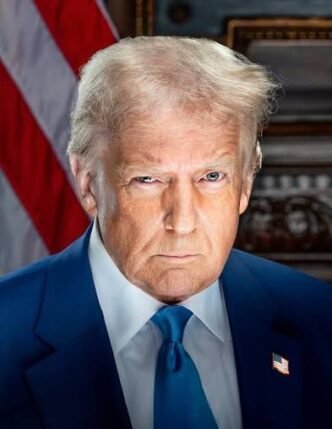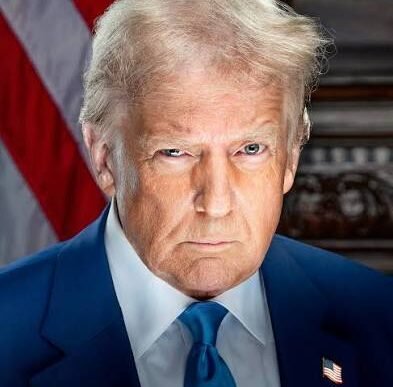




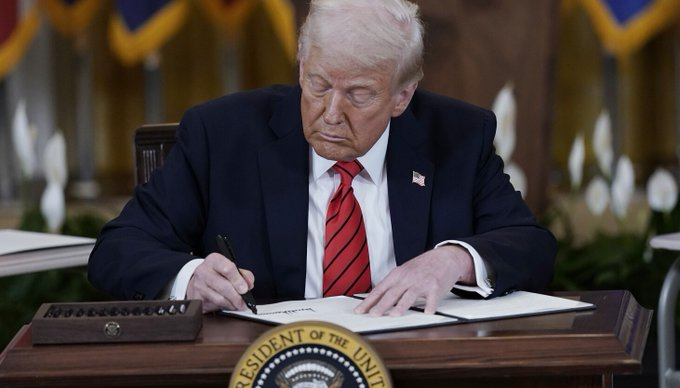
United States President Donald Trump has signed a memorandum of understanding with Iran aimed at ending hostilities and opening a new phase of diplomatic relations.
Eko Hot News reports that the signing took place shortly before a state dinner hosted by French President Emmanuel Macron at the Palace of Versailles, drawing global attention to the development.
Iranian President Masoud Pezeshkian also signed the agreement from Tehran, marking a coordinated diplomatic step between both nations.
US Vice President JD Vance is expected to append his signature at a formal follow-up ceremony scheduled to hold in Geneva.
Officials described the agreement as a major diplomatic milestone aimed at stabilizing long-standing tensions between the United States and Iran.
President Trump said the deal reflects strong negotiation outcomes and insisted that no previous administration had taken a tougher position on Iran.
He added that global markets responded positively to the announcement, describing economic stability as a key outcome of the agreement.
According to Trump, failure to reach an agreement could have led to wider global economic disruptions.
The agreement reportedly includes provisions related to maritime access, trade flows, and broader economic cooperation.
It also outlines steps toward easing restrictions on Iranian crude oil exports under specified conditions.
Additional elements include discussions around financial restructuring support and the unfreezing of certain Iranian assets.
Iranian negotiators, however, expressed skepticism about the agreement’s long-term impact.
Chief negotiator Mohammad Bagher Ghalibaf described the deal as evidence of US policy failure, saying it would be judged by future outcomes.
Under the terms, Iran is expected to limit the activities of some allied groups in the region and confirm non-development of nuclear weapons.
The agreement also proposes temporary toll-free passage for vessels through the Strait of Hormuz for an initial 60-day period.
Iranian officials indicated that future access terms may be revised after the initial phase concludes.
The deal has drawn mixed international reactions, with observers closely monitoring its implementation.
Analysts say the agreement could reshape diplomatic and economic relations across the Middle East if fully implemented.
Further formal procedures are expected as both sides move toward additional verification and compliance steps.