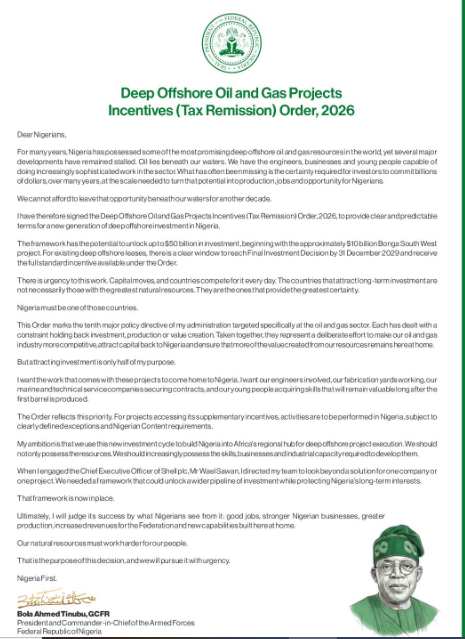




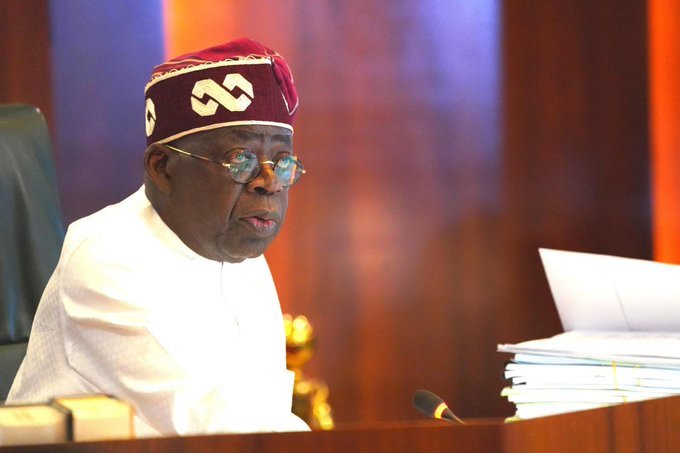
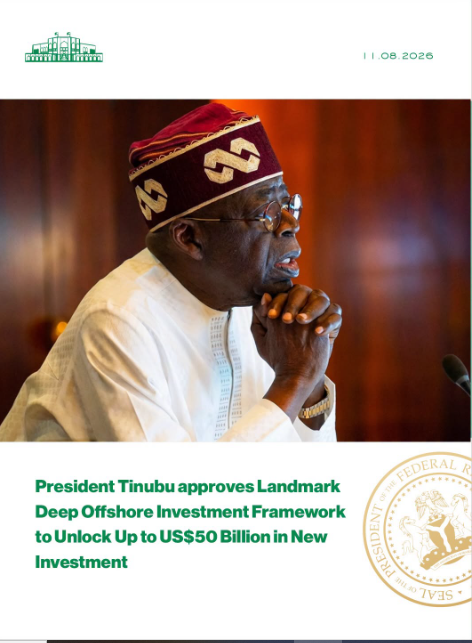
President Bola Ahmed Tinubu has signed the Deep Offshore Oil and Gas Projects Incentives (Tax Remission) Order, 2026, a policy expected to unlock up to $50 billion in deep offshore investments.
Eko Hot News reports that the new order is designed to provide greater certainty for investors and accelerate major offshore projects, beginning with the estimated $10 billion Bonga South West development.
Tinubu said the policy would help revive offshore opportunities that have remained delayed for several years.
The President noted that international investors require predictable policies when committing large sums of money to long-term projects.
Under the new framework, existing deep offshore leases will have until December 31, 2029, to reach Final Investment Decision and qualify for the full standard incentive.
The measure is part of the administration’s wider efforts to attract investment and improve activity in Nigeria’s oil and gas industry.
Tinubu described the order as the tenth major policy directive of his administration specifically targeted at the petroleum sector.
He said the government has been working to remove obstacles affecting investment, production and value creation in the industry.
According to the President, the expected investment should produce benefits that go beyond the headline financial figure.
He emphasised the need for Nigerian businesses and professionals to play major roles in the execution of offshore projects.
The administration wants Nigerian engineers to gain opportunities through the projects.
It also expects local fabrication yards to benefit from increased activity.
Nigerian marine and technical service companies are expected to secure more contracts as major offshore developments progress.
The President also highlighted skills development for young Nigerians as an important part of the initiative.
He said the government wants young people to acquire world-class technical skills through increased participation in the oil and gas industry.
The new framework includes supplementary incentives for qualifying projects.
For projects accessing those additional incentives, activities are expected to be carried out within Nigeria, subject to specified exceptions and Nigerian Content requirements.
The policy is therefore designed to encourage greater local participation in offshore project execution.
Tinubu said the government’s ambition is to position Nigeria as Africa’s regional hub for deep offshore project development.
The move could create opportunities for companies involved in engineering, fabrication, logistics, marine services and other technical areas.
It could also support the expansion of local expertise within Nigeria’s energy industry.

The Bonga South West project is expected to be among the major developments benefiting from the new investment framework.
The project has been identified as an important offshore opportunity with significant potential for investment and production.
The administration believes that creating a clearer investment environment could help accelerate decisions on projects of this scale.
The policy also comes amid efforts to strengthen Nigeria’s position as an attractive destination for international energy investment.
Global investors typically consider regulatory certainty, project timelines and fiscal conditions when making long-term commitments.
The new tax remission order is intended to provide clarity on those conditions for eligible deep offshore developments.
Tinubu said the government understands that capital can move to countries offering more competitive and predictable investment environments.
Nigeria is therefore seeking to improve the conditions for investors while ensuring that the country receives wider economic benefits.
The President stressed that investment must translate into opportunities for Nigerians.
He said the success of the policy would ultimately be measured by the jobs created and the businesses strengthened within the country.
Increased offshore activity could generate opportunities for Nigerian contractors and service providers.
It could also contribute to government revenue through increased production and economic activity.
Another expected benefit is the development of local technical capacity.
Nigerian professionals could gain valuable experience through participation in complex offshore projects.
The policy is also expected to support the government’s broader efforts to increase oil and gas production.
Improved investment flows could help move stalled projects toward development and production.
The administration has continued to introduce policy measures aimed at creating a more attractive environment for investors in the petroleum sector.
The latest order adds another major fiscal incentive to those efforts.
Tinubu said his administration remains focused on unlocking Nigeria’s energy potential while promoting greater local participation.
The emphasis on Nigerian Content is expected to encourage more project activities to take place within the country.
Local companies could benefit from procurement, engineering, fabrication, marine support and technical service opportunities.
Young Nigerians could also gain access to employment and specialised training linked to major offshore developments.
The President said the government wants the benefits of the investment to be visible across the Nigerian economy.
The expected $50 billion investment could therefore have implications beyond the oil and gas industry.
Higher economic activity can support businesses operating across several connected sectors.
The government also expects increased production to strengthen national revenue and support development priorities.
Tinubu’s latest directive signals continued efforts to reform the fiscal environment surrounding Nigeria’s offshore petroleum industry.
The 2029 deadline provides eligible existing leases with a defined period to make Final Investment Decisions.
This timeline is expected to give investors greater clarity when planning major capital commitments.
The government hopes the combination of incentives and regulatory certainty will accelerate project development.
Nigeria’s deep offshore resources remain an important component of the country’s energy potential.
Unlocking those resources could strengthen production and improve the contribution of the petroleum sector to the economy.
The administration’s focus on local participation also seeks to ensure that Nigerians benefit directly from increased offshore activity.
From engineering firms to technical service providers, several domestic businesses could gain from new projects.
The policy could equally encourage greater investment in skills development and specialised training.
Tinubu said the ultimate objective is to create jobs, strengthen Nigerian companies, increase production and generate greater revenue for the Federation.
The government will now look toward implementation of the new framework and the response of investors and project developers.
The Bonga South West project is expected to remain a major test of the policy’s ability to unlock long-delayed offshore investment.
If successfully implemented, the framework could strengthen Nigeria’s position in Africa’s deep offshore energy market.