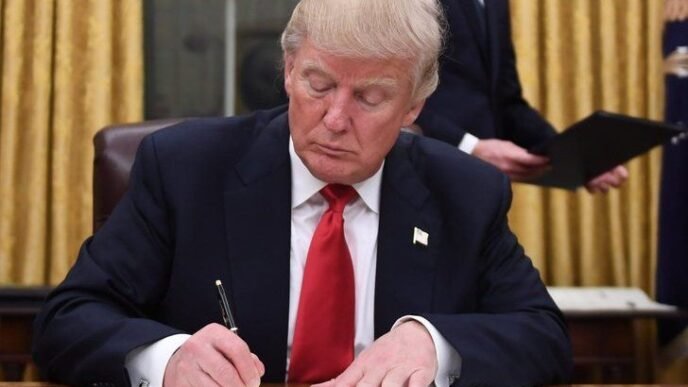





U.S. President Donald Trump has ignited fresh controversy after declaring that ABC should lose its broadcasting licence, following a tense exchange with an ABC News reporter over unreleased Jeffrey Epstein files.
Eko Hot News reports that the confrontation unfolded during an Oval Office media session with Saudi Arabian Crown Prince Mohammed bin Salman, where ABC News correspondent Mary Bruce pressed Trump on why his administration had not released the Epstein files despite bipartisan pressure from Congress. Both the U.S. House of Representatives and the Senate overwhelmingly backed a bill compelling the administration to make the documents public, but Trump avoided giving a direct answer on why he had not ordered their release himself. Instead, the former president shifted focus to Bruce’s line of questioning, accusing her of having a hostile attitude and calling her a “terrible reporter.”
Trump’s remarks quickly escalated from frustration with the individual reporter to broad criticism of the network itself. He repeated his longstanding assertion that he had “nothing to do” with Jeffrey Epstein, adding that he “threw him out of my club many years ago because I thought he was a sick pervert.” While Bruce attempted to steer the conversation back to the central question—why the executive branch had not simply released the files—Trump insisted that the scandal had been exaggerated by the media, referring to it as a “hoax” and directly accusing ABC of being among those “perpetrating” misinformation.
The most explosive moment came when Trump declared that ABC’s journalism was “so fake and so wrong” that the network should be stripped of its broadcasting rights altogether. He went as far as suggesting that Federal Communications Commission (FCC) Commissioner Brendan Carr should review ABC’s broadcast licence, a statement that sparked immediate debate among commentators and legal analysts. Calls for revoking a broadcaster’s licence are exceptionally rare in American political discourse, and Trump’s remark instantly became a flashpoint in ongoing conversations about press freedom, media bias, and political pressure on regulatory agencies.
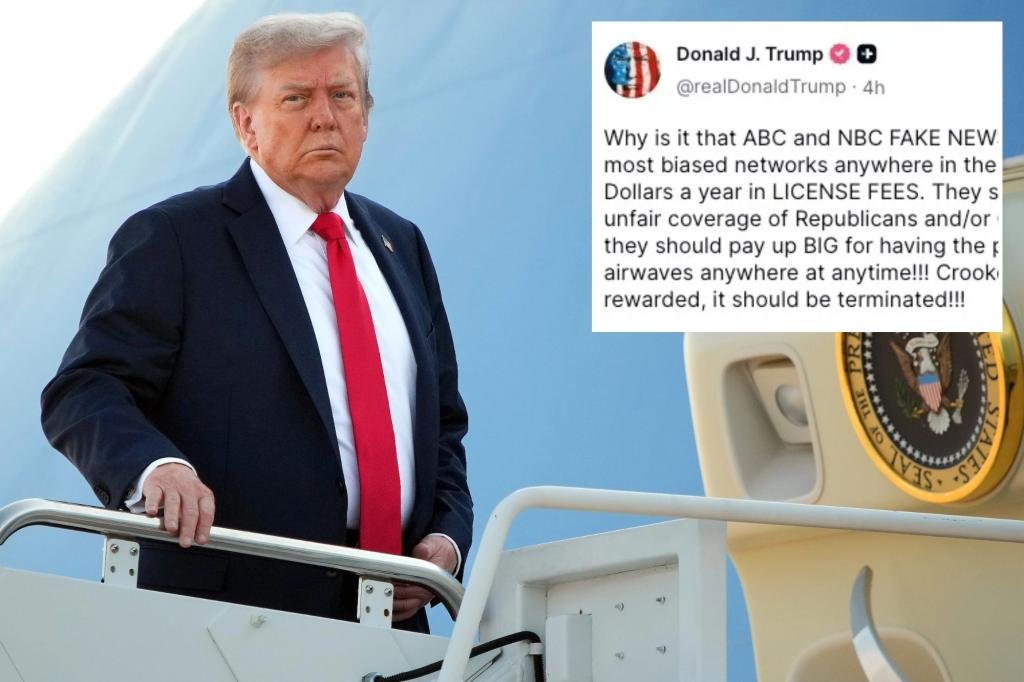
From a regulatory standpoint, revoking a major network’s licence is an extremely high bar, requiring clear evidence of violations such as repeated breaches of technical standards, failure to serve the public interest, or severe ethical misconduct. Criticism of a network’s reporting, no matter how intense, does not by itself meet FCC criteria. Still, Trump’s comments reflect a broader pattern in which he has publicly castigated major media outlets, particularly those he believes have covered him unfairly. His reference to the “ABC licence” aligns with this trend, serving both as a political statement and a rhetorical tool aimed at galvanising his supporters who distrust mainstream media institutions.
The exchange also placed renewed focus on the status of the Epstein files, which have become a subject of significant public interest in the United States and internationally. Lawmakers from both parties voted overwhelmingly to mandate their release, signalling rare bipartisan agreement. Despite repeated assurances from Attorney General Pam Bondi and other administration officials that the files would be released, no timeline has been provided. This delay has fuelled speculation and heightened journalistic scrutiny, contributing to tense moments like the one between Trump and Bruce.
For ABC News, the confrontation underscored the complexities of covering high-stakes political and legal issues involving public figures and sensitive investigations. The network has not publicly commented on Trump’s call to revoke its licence, but media experts widely noted that such statements, while unlikely to produce regulatory consequences, raise broader concerns about political leaders threatening media organisations. Press freedom advocates argue that such rhetoric can create a chilling effect, especially when directed at journalists who are performing accountability-driven reporting.
Meanwhile, Trump’s supporters view the confrontation as further evidence of what they see as media hostility toward him. For them, Trump’s demand to review the ABC licence represents a pushback against what they consider years of unfair or biased coverage. The divide reflects the ongoing polarisation in public attitudes toward the press, with major networks increasingly becoming symbols in broader cultural and political battles.
As the debate continues, one point remains clear: Trump’s remarks have thrust the ABC licence issue into the spotlight, ensuring further scrutiny not only of the network’s reporting but also of the political motivations behind calls for regulatory action. With the Epstein files still unreleased and Congress unanimously demanding transparency, the situation remains fluid, and media organisations will continue to play a central role in informing the public as developments unfold.